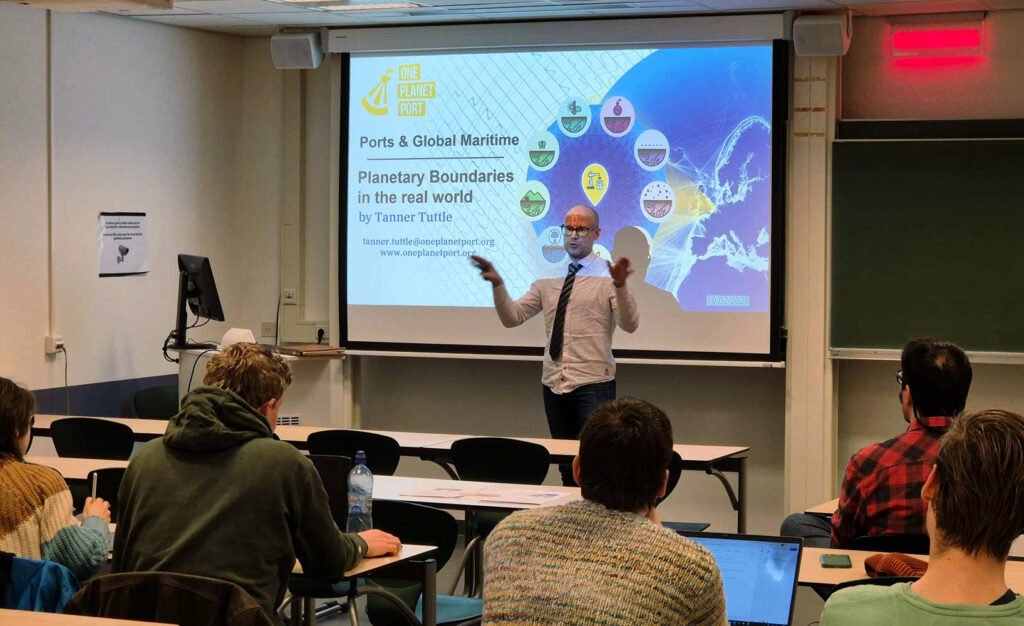
One Planet Port recently delivered a guest lecture in the Master’s course Critical Approaches 2025–2026 at the University of Groningen, convened by Dr. Ethemcan Turhan, Associate Professor of Environmental Planning, Politics and Society, and Dr. Christian W. Lamker, Associate Professor of Spatial Planning and Environment.
The session examined the interconnected relationship between GDP growth, the expansion of material extraction required to sustain it, and the resulting rise in ecological breakdown, using the nine planetary boundaries framework as a guiding lens.
The discussion then connected these systemic dynamics to ports. As critical nodes in global materials flows, ports are not peripheral to planetary instability. They are the physical gateways through which material and energy flows pass. If material throughput is a central driver of Earth-system destabilisation, then ports become key leverage points for change.
One Planet Port presented its alternative framework built on three pillars:
- Efficiency, improving operations within ecological limits
- Circularity, redesigning material flows
- Sufficiency, aligning trade and throughput with human well-being rather than unlimited growth
The session concluded by reflecting on what it means to work with planetary boundaries in practice. Sustainability knowledge becomes transformative only when it reshapes accounting systems, infrastructure access conditions, and investment logic. Navigating the tension between competitiveness and ecological limits is challenging but ports remain powerful sites where regenerative futures can be made materially a reality.